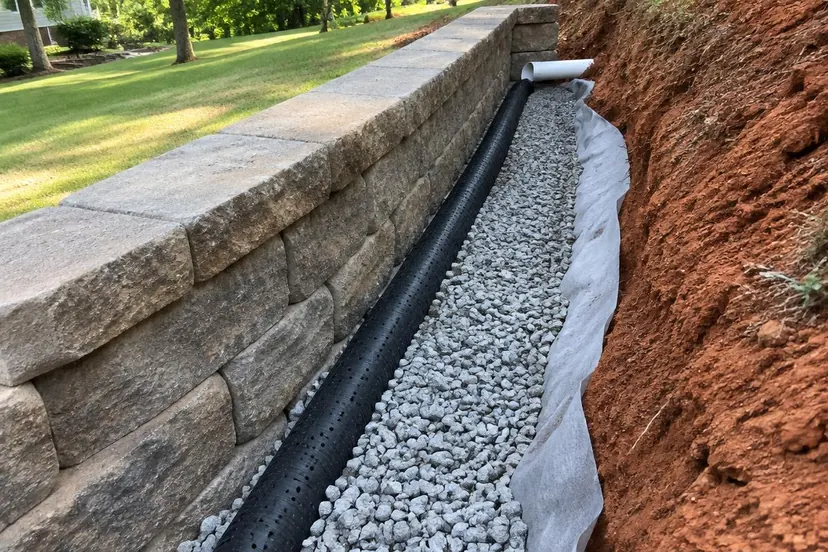
Greenville Pro Retaining Wall connects homeowners with independent local providers for drainage behind retaining walls throughout the Upstate of South Carolina. Gravel backfill, perforated drain pipe and appropriate weep holes to relieve trapped water.
Why retaining walls fail without drainage
Water held behind a wall adds pressure to the retained soil. After rain, saturated backfill can push the wall outward, wash soil through gaps or undermine the base. A stronger-looking face does not solve trapped water. Drainage is a structural part of the wall system, not just a way to dry the lawn.
Gravel backfill creates a drainage zone
Clean washed gravel gives water a path down behind the wall. Red clay packed directly against the face can hold moisture and restrict that path. Where appropriate, filter fabric separates the clay from the stone so soil fines do not fill the gravel voids.
Perforated drain pipe collects the water
A perforated pipe near the base gathers water from the gravel zone and carries it toward a planned outlet. Pipe placement, a continuous drainage path and access for future maintenance matter. A buried pipe with no working discharge point is not a complete drainage system.
Weep holes and outlets
Weep holes may provide discharge through some wall assemblies, particularly certain masonry walls. They must work with the backfill and wall design; adding a few holes is not a universal repair for every wall. Segmental systems often use pipe outlets at wall ends or other designed discharge points.
Surface water also needs a plan
Water from roofs, uphill lawns and patios should not be concentrated behind a wall. The provider reviews both surface runoff and the hidden drainage zone, and plans an outlet that does not simply move the problem to another part of the yard.
Retrofitting an existing wall
- Inspect wet spots, bulging and the visible outlets
- Check whether the drainage stone or pipe is clogged
- Assess whether excavation behind the wall is safe
- Replace failed drainage components as the repair requires
- Rebuild affected wall sections when drainage work alone is insufficient
Include drainage in every quote
Ask what gravel is included, how soil is separated from the drainage zone, where the perforated pipe runs and where water leaves the wall. Have the provider explain maintenance access before backfill conceals the system.
Typical residential budget
Small and mid-size residential retaining walls typically range from $1,500–$5,000. This is a typical planning range, not a fixed price or quote. Material, height, length, drainage and access can move a project outside it. Your independent provider sets the final price.
Confirm local requirements
Taller retaining walls (commonly those over about 4 feet) may require a building permit and an engineered design under local building codes. Homeowners should confirm with their city or county.
Request drainage behind retaining walls near you
Crews in our network work across the metro, including Greenville, Spartanburg, Greer, Simpsonville, Mauldin, Easley, Taylors, Fountain Inn and nearby towns. Call or use the form below to describe your project.